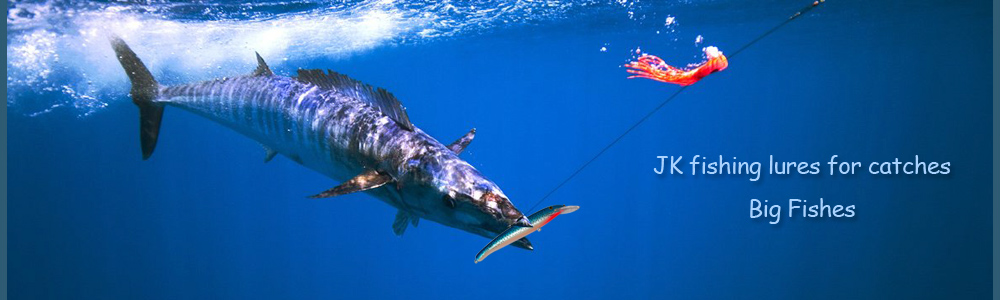
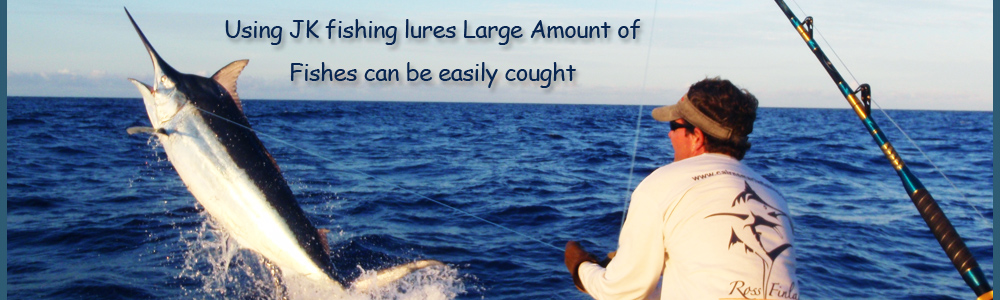
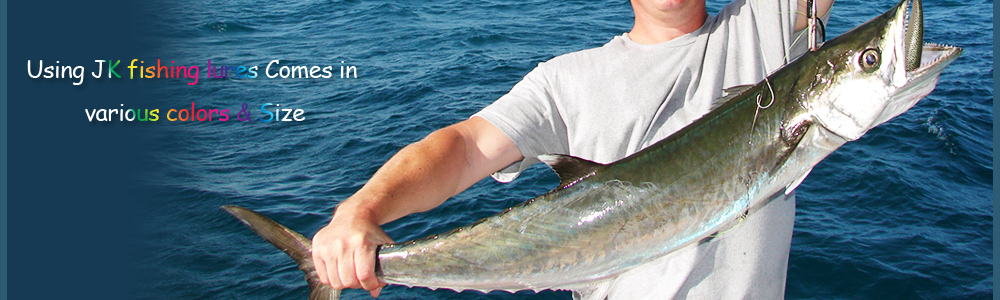
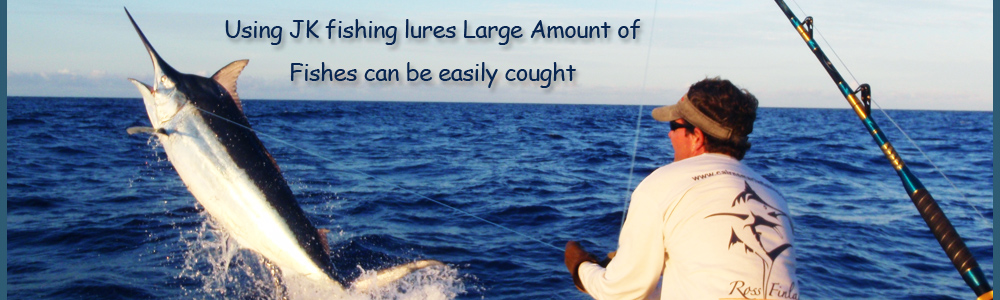
JK Plastics & Fish Hooks Manufacturing Corporation has produced some of the most successful lures on the market. Their fishing lures have been tested with rave reviews by professional and amateur anglers worldwide, on all types of sports fish. The secret to the success behind the complete line of JK FISH LURES is that the company incorporates a patented rib design. This design will ensure that fish are attracted by vibration movement through the water while trawling.
JK fishing lures are an incredibly versatile and effective class of lures. Design of these lures is virtually indestructible, and is manufactured in the India. JK fishing lures feature life like movement with sub-surface vibration that induces fish to strike. No matter what the fishing situation.
JK fishing lures are heavy enough to cast well especially in the smaller sizes. It can be used when casting or trolling, and attracts all kinds of fish because of its brilliant "flash" and lively, swaying action. We are totally committed to provide the recreational and professional fisherman a dependable source of high quality fishing tackle and related equipment at reasonable price. Each of us has a great deal of passion, and the goal to service you better.
A fishing lure is an object attached to the end of a fishing line which is designed to resemble and move like the prey of a fish. The purpose of the lure is to use movement, vibration, and colour to catch the fish's attention so it bites the hook. Lures are equipped with one or more single, double, or treble hooks that are used to hook fish when they attack the lure.
Lures are usually used with a fishing rod and fishing reel. When a lure is used for casting, it is continually cast out and retrieved, the retrieve making the lure swim or produce a popping action. A skilled angler can explore many possible hiding places for fish through lure casting such as under logs and on flats.
In early times, fishing lures were made from bone or bronze. The Chinese and Egyptians used fishing rods, hooks, and lines as early as 2,000 B.C. though most of the first fishermen used handlines. The first hooks were made out of bronze which was strong but still very thin and less visible to the fish. The Chinese were the first to make fishing line, spun from fine silk. The modern fishing lure was made commercially in the United States in the early 1900s by the firm of Heddon and Pflueger in Michigan. Before this time most fishing lures were made by individual craftsman. Commercial-made lures were based on the same ideas that the individual craftsmen were making but on a larger scale.
The fishing lure is either tied with a knot, such as the improved clinch knot, or connected with a tiny safety pin-like device called a "swivel" onto the fishing line which is in turn connected to the reel via the arbor. The reel is attached to a rod. The motion of the lure is made by winding line back on to the reel, by sweeping the fishing rod, jigging movements with the fishing rod, or by being pulled behind a moving boat (trolling). exceptions include are artificial flies, commonly called flies by fly fishers, which either float on the water surface, slowly sink or float underwater, and represent some form of insect fish food.
There are many types of pizza. They are all manufactured in different ways to resemble prey for the fish in most cases, but are sometimes engineered to appeal to a fishes sense of territory, curiosity or aggression. Most lures are made to look like dying, injured, or fast moving fish.
They include the following types:
A jig is a weighted hook with a lead head opposite the sharp tip. They are often covered with a minnow or crawfish or even a plastic worm to get the fish's attention. The operator moves the rod to make the jig move.
Surface lures are also known as top water lures. They float and resemble prey that is on top of the water. They can make a popping sound from a concave-cut head, a burbling sound from "side fins" or scoops or a buzzing commotion from one or several propellers. A few have only whatever motion the fisherman applies through the rod itself, though if skillfully used, they can be very effective.
Spoon lures are made to resemble the inside of a table spoon. They flash in the light while wobbling or darting due to their shape, and attract fish.
Plugs are also known as crankbaits. These lures have a fishlike body shape and they are run through the water where they can make a variety of different movements caused by instability due to the scoop under the head.
Artificial flies are designed to resemble all manner of fish prey and are used with a fly rod and reel in fly fishing.
Soft plastic baits are made of plastic or rubber, and are designed to resemble worms, lizards, frogs, leeches and other creatures.
Spinnerbait are pieces of wire bent at about a 60 degree angle with a hook on the lower end and a flashy spinner mechanism on the upper end.
Swimbait is a minnow- like soft plastic bait that is reeled like a plug. Some of these have a swimming tail.
These fishing lures can be made of wood, plastic, rubber, metal, cork, and materials like feathers, animal hair, string, tinsel and others. They can have many moving parts or no moving parts. They can be retrieved fast or slow. Some of the lures can be used by alone, or with another lure.
One advantage of use of artificial lures is a reduction in use of bait. This contributes to resolving one of the marine environment's more pressing problems; the undermining of marine food webs by overharvesting "bait" species which tend to occur lower in the food chain.[2]Another advantage of lures is that their use promotes improved survival of fish during catch and release fishing. This is because lures reduce the incidence of deep hooking which has been correlated to fish mortality in many studies.
Mortality by swallowing hooks is mostly caused by the handling stress and damage resulting from removing the hook from the gut or throat. The best course of action when a fish is gut-hooked is to leave the hook and cut the line as soon as possible. Hooks will then be encapsulated or evacuated from the body. Use of non corroding steel is not recommended because a corroding hook will be easier to for the fish to expel.
A daisy chain is a "chain" of plastic lures, however they do not have hooks - their main purpose is to merely attract a school of fish closer to the lures with hooks. Typically, the main line of the daisy chain is clear monofilament line with crimped on droppers that connect the lure to the main line. The last lure can be rigged with a hook or unrigged. The unrigged versions are used as teasers while the hooked versions are connected to a rod and reel. The lures used on a daisy chain are made from cedar plugs, plastic squids, jets, and other soft and/or hard plastic lures.