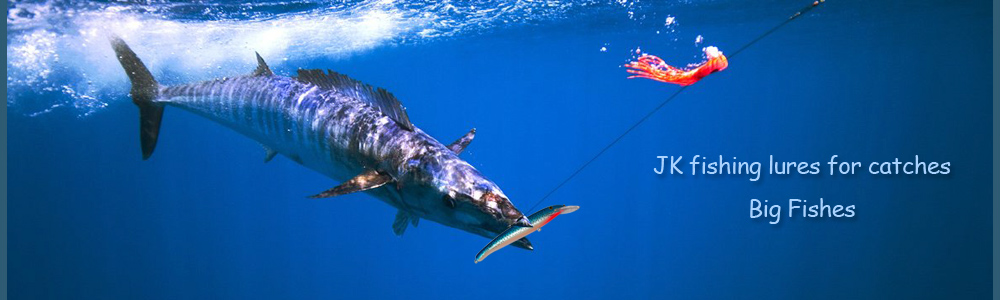
A fishing lure is an object attached to the end of a fishing line which is designed to resemble and move like the prey of a fish. The purpose of the lure is to use movement, vibration, and colour to catch the fish's attention so it bites the hook. Lures are equipped with one or more single, double, or treble hooks that are used to hook fish when they attack the lure..
Lures are usually used with a fishing rod and fishing reel. When a lure is used for casting, it is continually cast out and retrieved, the retrieve making the lure swim or produce a popping action. A skilled angler can explore many possible hiding places for fish through lure casting such as under logs and on flats.
Pull the lure fast through the water using the rod then retrieve the slack line and repeat it again, this will often attract a strike from even the wariest predators.
The JK Laser Pro Range of trolling and casting lures, precision built for maximum fish catching ability. Extra secure hook anchoring and towing points that are an integral part of the lure body.
Use the "rip and stop" technique on the standard version for explosive surface strikes. Note that when the lure stops moving it is pointing slightly left or right with the nose slightly down. It is in the ideal position for an immediate and erratic action when ripped.
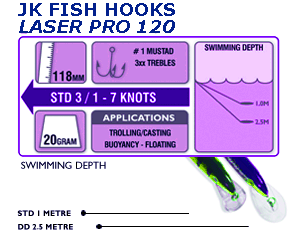
The small sinking Laser Pro 140, has a myriad of uses. It is mainly used for casting and its rear weighting assists in distance casting. The lure sinks slowly and maintains its horizontal profile. Try casting and doing a normal retrieve or try an erratic retrieve, even stopping the lure after a rapid pull. This helps keep the lure in the strike zone for longer and also is a strike trigger for many predatory fish. Try letting the lure sink to a predetermined depth before retrieving. This allows you to fish all areas of the water profile.
Hold the lure at the surface then let it sink where you can see it. Count how long it takes for the lure to sink to the depth you want. When you cast, you can do the count before retrieving and you will know the depth the lure is swimming at.
Products also works well with speed boats and with any depth .
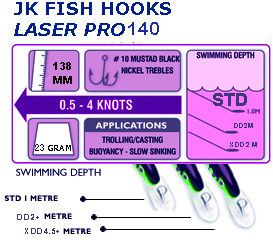
jk fish hooks india
The small sinking Laser Pro 140, has a myriad of uses. It is mainly used for casting and its rear weighting assists in distance casting. The lure sinks slowly and maintains its horizontal profile. Try casting and doing a normal retrieve or try an erratic retrieve, even stopping the lure after a rapid pull. This helps keep the lure in the strike zone for longer and also is a strike trigger for many predatory fish. Try letting the lure sink to a predetermined depth before retrieving. This allows you to fish all areas of the water profile.
Hold the lure at the surface then let it sink where you can see it. Count how long it takes for the lure to sink to the depth you want. When you cast, you can do the count before retrieving and you will know the depth the lure is swimming at.
Products also works well with speed boats and with any depth .
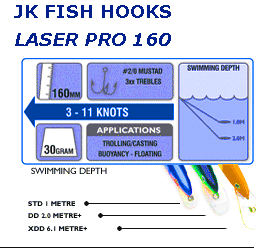
jk fish hooks india A great Bluewater trolling lure, the Laser Pro 160 can be trolled over a wide speed band, however its optimum speed for trolling for pelagics is around 6.5 knots. Troll lures at distances ranging from 10 to 50 metres from the boat. About 25 metres is normal. Troll more than one lure at once to increase your chances and emulate a school of fish. When trolling for toothy pelagics such as mackerel remember to use a Halco Snap or Supa Snap Trace.
Remember, always troll your lures at different distances from the boat. Not only does this cover more area, it also avoids tangles when turning the boat, as the closer lure will pass under the further lure during the turn.
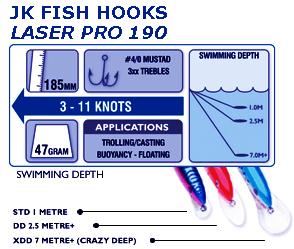
Now widely recognised as one of the world’s best bluewater trolling lures, this lure can be trolled over a wide speed band, however its optimum speed for trolling for pelagics is around 6.5 knots. Troll lures at distances ranging from 10 to 50 metres from the boat. About 25 metres is normal. Troll more than one lure at once to increase your chances and emulate a school of fish.
Remember, always troll your lures at different distances from the boat. Not only does this cover more area, it also avoids tangles when turning the boat, as the closer lure will pass under the further lure during the turn.